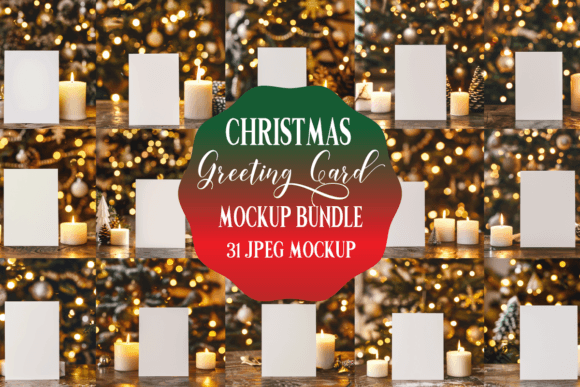
Review: Christmas Greeting Card Mockup 28 for Holiday Crafts
As someone who spends half the year digitizing and stitching for small business owners, I approach every new asset with a critical eye. We all know the feeling of downloading a design asset that looks stunning on a screen but falls apart the moment the needle hits the fabric. Today, I am evaluating Christmas Greeting Card Mockup 28. While this item is technically listed under Product Mockups and Graphics, my interest lies in how it serves as a visual foundation for planning real-world embroidery projects. Specifically, I want to determine if this high-resolution JPEG provides enough clarity and realism to help us visualize a finished product before we commit to stitching.
The Visual Personality and First Impressions
Upon opening the file, the first thing that strikes me about Christmas Greeting Card Mockup 28 is its clean, professional presentation. In the world of craft business, presentation is everything. This mockup does not scream "holiday" with overwhelming red and green clutter; instead, it offers a sophisticated, blank canvas that feels ready for personalization. The lighting is soft but directional enough to show texture, which is crucial when you are trying to imagine how a satin stitch or a dense fill stitch will sit on the surface.
For an Etsy seller or a boutique owner, the mood here is versatile. It feels premium. It suggests that whatever machine embroidery design you place upon it will be treated with care. The layout is spacious, avoiding the cramped feeling that often plagues free templates. This gives me confidence that whether I am planning a delicate baby embroidery motif or a bold logo for a tote bag design, the visual context will support the work rather than distract from it. It creates an immediate sense of trust, which is exactly what we need when showing potential clients what their personalized gift could look like.
Real-World Application: From Screen to Stitch
Let's walk through a realistic scenario. Imagine you are preparing a custom order for a local boutique that wants a line of holiday embroidery items. They need to approve the placement and scale of a new applique design before you cut a single piece of fabric. This is where Christmas Greeting Card Mockup 28 becomes invaluable. Because the included JPEG is logo-free and completely blank, it acts as a perfect neutral background.
I can easily composite a digital version of my embroidery file onto this mockup to show the client how a sweatshirt embroidery crest would look on a chest pocket, or how a festive motif would appear on a kitchen towel. Even though this is a graphic file and not a stitch file itself, its high resolution allows me to simulate the look of thread colors against the card stock or paper texture implied by the image. It helps bridge the gap between the digital digital embroidery file and the physical handmade product.
Consider a small shop product line featuring embroidered patches. Using this mockup, I can visualize how a circular patch with intricate running stitch details would look when packaged or displayed alongside a greeting card. It helps in creating cohesive branding for commercial embroidery projects. If you are selling printable mockup services to other designers, this asset is a goldmine because it saves hours of photography setup time while delivering a result that looks professionally shot.
Navigating Fabric Textures and Stitch Density
While Christmas Greeting Card Mockup 28 is a graphic tool, using it effectively requires an understanding of how embroidery interacts with different surfaces. When I use this mockup to plan a project, I am constantly thinking about the transition from the smooth visual of the JPEG to the tactile reality of fabric.
If I were adapting a design seen in this mockup for a textured fabric like a waffle-weave towel or a thick wool blend, I would need to adjust my stitch density. A design that looks crisp on the high-res screen might sink into a plush towel if the stitches are too sparse. Conversely, on a thin, stretchy fabric like a baby onesie, a dense design could cause puckering. The clarity of this mockup allows me to spot potential issues with tiny lettering or detailed corners before I hoop the fabric. It reminds me to check if my hoop size is sufficient for the design dimensions I am visualizing.
There are situations where caution is required. If you are planning to use the visual style of this mockup for a curved surface like a cap, remember that the flat perspective of the JPEG won't show distortion. You must mentally adjust for the curve. Similarly, for dark fabrics, the contrast seen in the bright mockup might not translate directly; you may need to add underlay stitches or change thread shades to maintain visibility. Always test your embroidery project on scrap fabric first. No amount of digital previewing replaces a physical stitch-out to check tension and registration.
Enhancing Brand Consistency and Customer Trust
In the competitive landscape of custom apparel and handmade goods, consistency builds brand recognition. Christmas Greeting Card Mockup 28 aids in maintaining a professional aesthetic across your marketing materials. Whether you are creating social media posts, website banners, or email newsletters, using a consistent, high-quality base image signals professionalism.
When a customer sees a clear, well-lit representation of your work, their confidence in your ability to deliver a high-quality finished product increases. This is particularly important for wedding gifts or high-end nursery decor where expectations are sky-high. The mockup helps you articulate the value of your work. It allows you to say, "Here is exactly how your monogram will look," reducing the back-and-forth communication and setting clear expectations. This level of clarity fosters buyer engagement and can significantly boost conversion rates for your Etsy listings or online store.
Practical Notes for the Working Designer
Before you integrate Christmas Greeting Card Mockup 28 into your workflow, keep these practical tips in mind to ensure the best results:
- Verify Licensing: Since this is a graphic asset, always confirm the license terms regarding commercial use. Ensure you are allowed to use the mockup images to sell your own physical or digital products.
- Check Resolution: The product description states you receive one high-resolution original JPEG. Ensure this resolution matches your output needs, especially if you are printing large format marketing materials.
- Contrast Testing: When compositing your designs, test them in black and white versions of the mockup to ensure the shape and form of your embroidery hold up without relying on color.
- Stabilizer Selection: Remember that while the mockup looks perfect, your actual fabric will need the right stabilizer. Cut-away for stretchy knits, tear-away for stable wovens, and water-soluble for towels.
- Thread Matching: Use the mockup to select thread colors, but always compare them against your physical thread chart under natural light, as screens can vary in color accuracy.
- File Formats: Note that this product includes JPEG images only. It does not include layered PSD files or vector formats, so your editing capabilities will be limited to what you can do with a raster image unless you have advanced editing skills.
Ultimately, Christmas Greeting Card Mockup 28 is a solid utility player in the designer's toolkit. It may not be a stitch file, but its role in visualizing, planning, and selling embroidery designs is significant. By providing a clean, professional stage for your creativity, it allows you to focus on what you do best: creating beautiful, lasting handmade products that bring joy during the holiday season and beyond.